
Nearly 80 domestic and international flights received bomb threats in less than 24 hours that later turned out to be hoaxes, keeping thousands of passengers and security agencies on tenterhooks.
In June IndiGo had implemented a mandatory leave without pay program for 1.5 days to 5 days. Subsequently, in July, IndiGo announced 5.5 additional days of LWP for its pilots, taking the effective number of LWP to 10 days. As cost cutting measure, the airline had also let go of 10 per cent of its employees and implemented a pay cut across the board.

Analysts remain sceptical on the profitability from freighter business, saying that once normal air transport resumes and there's abundant belly capacity, the traditional economics of air cargo may not be that lucrative.
While IndiGo had 11.8 per cent of all the international seats to and fro India in the last week of August, Air India's seat share was 11.4 per cent. Emirates came third with 8.1 per cent, and rest of the airlines constituted 68 per cent of the seat share.
The initial speculation over who is likely to down shutters seems to have given way to a resigned acceptance that all the players are determined to stay in the game.
Despite the best ever quarterly net profit of Rs 3,091 crore during April-June of financial year 2023-24 (Q1FY24), challenges are mounting for InterGlobe Aviation-run IndiGo in the near term, said analysts. Given this, most brokerages have retained their ratings from 'buy to underperform', as well as their target price for the stock. For instance, Motilal Oswal Financial Services has retained its 'neutral' rating on the scrip as it believes the low-cost airline is facing teething issues at present.
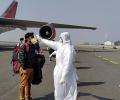
Within two weeks of many airlines deciding to roll back salary cuts encouraged by a steady increase in traffic flow, a second wave of coronavirus along with rules of compulsory RT-PCR test has hit forward bookings. The fears of last summer, when the pandemic had overturned all the wisdom of airline boardrooms, have returned to haunt the aviation industry. According to an official in the Ministry of Civil Aviation, flight occupancy is down to 60 per cent from 70 per cent in the first week of March. Airline lobby group IATA estimates that low cost airlines need to fly at 80 per cent occupancy to be profitable.
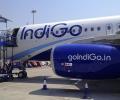
IndiGo, India's largest airline, is in talks to raise fresh funds as a second wave of pandemic has led to collapse in travel demand. The airline may look to raise Rs 3,500-4,000 crore. On Monday, only 97,761 passengers flew. With flyers cancelling bookings, airlines had to put aside flights and operated only 1,306 of them.

Around 1.12 crore domestic passengers travelled by air in December, approximately 6.7 per cent higher than the 1.05 crore who travelled in November, the country's aviation regulator said on Wednesday. Overall, 8.38 crore people travelled on domestic flights in 2021 as compared to 6.3 crore in 2020, showing a jump of 33 per cent, the Directorate General of Civil Aviation (DGCA) stated in its monthly statement. IndiGo -- India's largest carrier -- carried 61.41 lakh passengers in December, a 54.8 per cent share of the domestic market, it mentioned.
People in the know said the move would impact around 110 engines, virtually putting a spanner on the expansion plans of IndiGo - counted among the fastest growing airlines in the world.
The number of domestic air travelers in India grew 2.42 per cent year-on-year (Y-o-Y) in April, reaching 13.2 million, according to data by the Directorate General of Civil Aviation (DGCA) on Tuesday.

Aditya Ghosh, with no prior aviation background or MBA degree, managed not only to become the CEO of an airline but even piloted it to the top with almost half of the market.
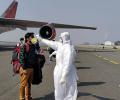
'The recent price hike would only be beneficial if the airlines continue to operate at 80 per cent airline capacity. An increase towards 90 or 100 per cent airline capacity would again add pressure to the fares as demand remains muted. Also, we are in the fourth quarter of the fiscal year which is a seasonally weaker quarter,' says an analyst.
The price of aviation turbine fuel has increased by 50 per cent since January and the situation has adversely impacted IndiGo, its CEO Ronojoy Dutta said on Wednesday. He said the government should bring aviation turbine fuel (ATF) under the Goods and Services Tax (GST) and make flying affordable for consumers and viable for airlines. IndiGo is India's largest airline and with around 55 per cent share in the domestic passenger market.
IndiGo had the best on-time performance (OTP) of 95.4 per cent at four metro airports in February, while Go First secured the number two position with 94.1 per cent in the same month, according to data released by aviation regulator DGCA. Bengaluru, Delhi, Hyderabad, and Mumbai were the four airports where Indigo had the best OTP, the data released on Monday said. In January, the situation was inverse as Go First had logged the best OTP of 94.5 per cent at the four airports while IndiGo was at number two with 93.9 per cent OTP.
IndiGo is facing acute shortage of commanders amid aggressive expansion of its fleet. The carrier has more than 210 planes in its fleet.

This is a setback for the divestment process of Air India as no other Indian airline has the capability to fund the process
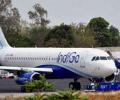
IndiGo which has close to 40 per cent market share, at present has 129 aircraft and operates 883 daily flights to 44 destinations. It also has around 400 aircraft on order.

IndiGo's co-founder and interim CEO Rahul Bhatia said profitability was significantly impacted by costs pressure from the increases in fuel price and the depreciation of rupee as well as competitive fare environment.

Of the 48 flights, which are not being operated as part of the curtailed schedule, 42 are of IndiGo and six of GoAir.
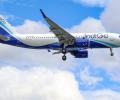
The sources said the passenger informed the cabin crew that he has tested positive for coronavirus, following which the aircraft returned to the bay and the person was offloaded.
IndiGo is providing digital solutions to everyday problems, attracting customers to digital platforms and engaging start-ups to find solutions

The plan is to charge 30 per cent less. Travel sector executives say if IndiGo is able to do so, it could create a new class of flyers.
Rahul Bhatia, a promoter of the company, has been appointed as the interim CEO.
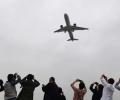
Notwithstanding the sweltering heat engulfing major cities, travellers can find solace in the steady airfares to popular summer destinations like Srinagar, Bagdogra, and Kochi. According to airline executives, capacity increases and moderate demand have kept spot airfares from scorching cities like Delhi on a par with the same period last year.

According to the annual report, Ronojoy Dutta's remuneration package includes a gross annual salary of $1.27 million, which would be payable in rupees. Also, he is entitled for a commitment bonus payout. In FY20, he received a remuneration of Rs 11.4 crore in his role as CEO and whole-time director.

The IAF pilots, who are middle-aged, are willing to fly any number of hours, as they are keen to make quick money before they retire

More than 80 domestic and international flights of various Indian airlines received bomb threats on Thursday, according to sources.
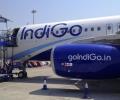
This is the second incident in six months of an untoward incident involving IndiGo staff.
The recent spate of technical glitches in aircraft has prompted the Directorate General of Civil Aviation (DGCA) to issue an order on July 18, making aircraft maintenance engineers (AMEs) with category B1/B2 licences the final authorities in certifying planes. This has put the spotlight on the availability of such personnel. According to the order, airlines were resorting to frequent one-off authorisation by the Category A certifying staff at transit stations, which is not in line with existing regulatory provisions.
Initially, starting with a slightly curtailed capacity, the airline will increase the operating capacity over the subsequent months, also reopening selected international flights, depending on the existing international travel guidelines: IndiGo.
The carrier said for domestic flights the fees for cancellation and changes would now be Rs 3,500 and Rs 3,000 respectively, if it was done within three days of the flight's departure. Before this announcement, IndiGo charged a flat rate of Rs 3,000 and Rs 2,500 for cancellation and detail changes on domestic tickets.
India's largest carrier IndiGo will cut 20 per cent of its flights due to lower demand as a rapidly spreading coronavirus upends the recovery of air travel. The airline was operating around 1,200 flights as on Saturday. Other airlines are being forced to cancel flights as states tighten restrictions to combat the spread of the virus, and people are dropping last-minute travel plans. Airlines carried 2,518 passengers on 260,251 flights on Saturday, compared to 2,794 passengers on 358,856 flights the day before.

'$125 million for the hull and the remaining of over $350 million for liability.'

Kamra allegedly heckled Goswami, the editor of Republic TV, on IndiGo's Mumbai-Lucknow (6E5317) flight on Tuesday.

The pilot wrote in his letter to airline's management that he was 'disheartened' to learn the carrier took action against the comedian without consulting him and solely on the basis of social media posts.

Many argue that the airline could achieve its full potential if Nusli Wadia were to run it the way he does Britannia.
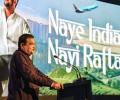
From highways connecting once-remote regions to aviation networks carrying millions, India's infrastructure story is one of transformation.
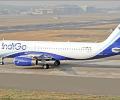
The introduction of these new flights would help IndiGo cross 650 flights mark as the it would offer a total of 671 flights per day connecting 39 destinations.

Given its network and fleet, it has garnered the highest share of passenger growth.
